 Insights




Art Therapy:
Visualizing Our Thoughts
Imagine trying to explain anxiety without using the word anxiety. Maybe it feels like a knot. Or static. Maybe it has sharp edges, or takes up too much space. Perhaps it’s red, gray or a color that doesn’t have a name. Now imagine being asked to draw it.
For some, that might feel easier than explaining exactly what is happening inside their minds. For others, it might feel awkward or impossible. Either response raises an interesting question: Can creating something help us approach experiences that are difficult to put into words? That idea sits at the heart of art therapy, which combines art-making with psychotherapy. Research suggests it may help people experiencing anxiety, depression and other forms of psychological distress.SourcesAmerican Art Therapy Association; Joschko et al., 2024.
Another way to communicate
Much of traditional psychotherapy relies on conversation, but translating an internal experience into language is a surprisingly complex task. We first have to recognize what we are feeling, make sense of it, and then find the words to communicate it to someone else. Sometimes those words aren’t readily available or difficult to articulate.
Art can provide another form of expression. An art therapist might invite someone to work with paint, pencils, clay or collage. Artistic ability isn’t the goal, and the finished artwork isn’t treated as a puzzle for the therapist to decode. Instead, the process of creating can provide another way to explore an experience and, sometimes, a starting point for conversation.
This may be especially valuable for children and adolescents.
A 2024 systematic review and meta-analysis examined six studies involving 422 children and adolescents and found that art therapy was associated with reductions in anxiety. The researchers noted limitations, including the relatively small number of studies and substantial differences among them, but the results add to evidence suggesting art therapy may have a role in supporting young people’s mental health.SourceZhang et al., 2024.
Trauma-based art therapy
Trauma is one area where researchers are particularly interested in arts-based approaches. A 2024 meta-analysis of 21 randomized trials involving 868 people who had experienced trauma found encouraging effects on positive outcomes such as quality of life. Overall effects on PTSD-specific symptoms fell just short of statistical significance, although an analysis specifically involving children found significant reductions in PTSD symptoms. More recent research focused on children and adolescents has also reported promising results for some symptoms while concluding that the evidence remains too limited to determine how effective individual arts therapies are.SourceMaddox et al., 2024.
Children communicating through art
The idea that art can offer young people another way to process difficult experiences is closely tied to the origins of The 72 Fund, which began with a six-year-old’s simple idea: to send art materials to children affected by the war in Ukraine. She understood from her own experience how meaningful art could be; after the loss of her grandfather, creating became a way for her to express and work through feelings that were difficult to put into words.
That impulse, to give other children access to the same kind of creative outlet, helped inspire The 72 Fund. What began with art supplies has since grown into support for art therapy programs in regional and international institutions. The organization’s story is also a reminder of something easily overlooked when adults talk about children’s well-being; sometimes the most important thing we can do is listen to what young people tell us they need.
Open a section below to read more.
What changes when you make a feeling visible?
Think about a difficult emotion without naming it. If you had to represent it using only lines, would they be straight or tangled? Heavy or faint? Would they stay in one corner of the page or cover the whole thing?
There is nothing diagnostic about your answer, but the exercise illustrates something unusual about art-making; an experience that previously existed only internally can become something physical. You can look at it. Touch it. Change it. Add something to it. Cover part of it. Show it to someone, or decide it’s for your eyes only.
Researchers have a name for one process that may help explain this experience: concretization. Instead of an emotion or experience existing only internally, art-making can give it a perceptible form; something that can be seen, changed and explored. A review of research into creative arts therapies identified concretization, along with embodiment and the use of symbolism and metaphor, as processes particularly characteristic of arts-based therapies. Scientists have not established that any one of these processes is responsible for better mental health outcomes, but they provide testable theories for how creative expression might contribute to therapeutic change.
Sourcesde Witte et al., 2021.Is making art itself therapeutic?
You don’t have to be in therapy to know that creative activities can affect how you feel. Creating involves attention, sensory engagement, decision-making and experimentation. It can also be absorbing, allowing us to focus on what is happening in the present moment.
Researchers are beginning to investigate what might be happening beneath that experience. In one small study, 39 healthy adults spent 45 minutes making art. The study showed that levels of cortisol, a hormone involved in the body’s stress response, decreased significantly afterward in about three-quarters of participants.
The study examined art-making rather than clinical art therapy, so it doesn’t show that art therapy itself lowers cortisol. But it offers one clue about how creative activity may interact with stress.
SourceKaimal et al., 2016.Small brain-imaging studies have also found that drawing and other forms of art-making engage brain regions involved in processes such as reward. These findings are preliminary, however, and scientists caution against simple claims that art “rewires the brain.” Creative activity engages sensory processing, attention, movement, emotion and cognition simultaneously, and researchers are still working to understand how these processes may contribute to mental health.
SourceKaimal et al., 2017.The Important Role of the Therapist
Imagine two people making exactly the same painting. One is sitting alone at a kitchen table. The other is working with a trained art therapist who notices how they approach the task, listens to what comes up, asks questions and helps them explore connections between the creative process and experiences elsewhere in their life.
The materials are identical. The experience isn’t.
Art that feels therapeutic and art therapy are not interchangeable. Credentialed art therapists have graduate-level mental health and art therapy education as well as supervised clinical training. Art-making takes place within a therapeutic relationship.
SourceAmerican Art Therapy Association.That relationship may be part of what makes the process therapeutic. Research into creative arts therapies has identified factors such as feeling safe and developing a strong therapeutic alliance (the collaborative relationship between therapist and client) as possible mechanisms of change.
Sourcede Witte et al., 2021.In that sense, asking whether it is “the art” or “the therapy” may create a false choice. The potential benefits may come from the way creative expression and the therapeutic relationship work together.
Art therapy during physical illness
Researchers have also explored art therapy as a source of psychological support during serious illness.
A 2025 meta-analysis of 17 studies involving 1,237 women with breast cancer found that arts-based therapeutic interventions were associated with significant reductions in anxiety and depression. The review included several forms of creative therapy, however, including music and movement as well as visual art.
SourceHuang & Yin, 2025.Other studies have focused specifically on art therapy. In one randomized study, women receiving radiotherapy for breast cancer participated in five individual art therapy sessions. Four months later, the art therapy group reported lower depression, anxiety and physical symptoms than the control group.
SourceThyme et al., 2009.These approaches aren’t intended to replace medical or mental health treatment, but may provide an additional form of support during physically and emotionally demanding experiences.
Explore further
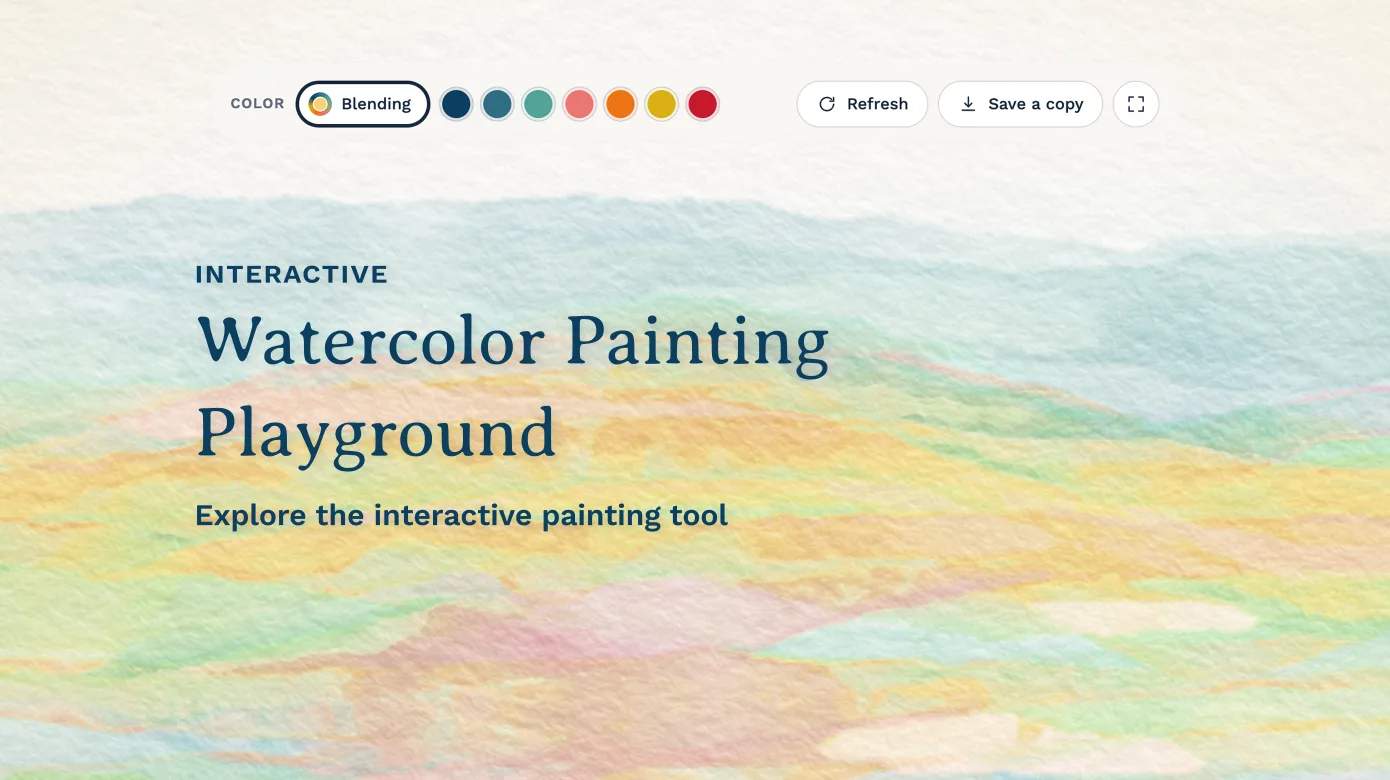
A Different Way
We often assume that understanding what we feel begins with finding the right words. Art therapy offers another place to start – with a color, a line, a piece of clay, or an image that doesn’t yet have an explanation.
The artwork doesn’t have to be beautiful or reveal a hidden truth. It may simply give someone another way to begin.