 Insights



Music Therapy: The Sounds of Healing
Alana Shortt of The 72 Fund describes her experience with her father and the power of music.
“Music is in my father’s blood. After founding The Zimriyah Choir in the late 1950s, he spent over six decades conducting numerous chamber groups and choirs, including the Birmingham University Guild Choir and The Quinborne Choir. Music wasn’t simply something he enjoyed; it was part of who he was.”
When I was a child, we would listen to Classic FM together in the car. A piece would come on and within five seconds Dad could tell me the composer and the name of the work. He was never wrong. As I got older, it became a game between us. I’d try to identify the music first, but I was competing with decades of musical knowledge, so the odds weren’t exactly in my favor.
Years later, dementia changed the game.
When my father was in the hospital, I played him some of the music he had loved listening to with my mother, who had died several years earlier. For a moment, our old game returned. He lifted his head, turned to me, and said, “Albinoni! Adagio in G Minor!”
He could still tell me the name of the piece and who had composed it, yet he couldn’t remember how many children he had.
I found that contrast almost impossible to comprehend. How can someone lose access to such a fundamental fact about their own family, yet hear music from years earlier and still recognize it?
What is it about music that reaches us when other forms of communication sometimes cannot?
Long before children can express themselves in words, they respond to sound. Babies recognize familiar voices and respond to changes in rhythm, pitch, and melody. A caregiver sings and the baby listens; the baby vocalizes and the caregiver responds. Communication begins before language.
That capacity to connect through sound is part of what can make music such a powerful therapeutic tool for children. Music does not require a child to find the right words. Through sound, movement, rhythm, or even silence, a child can express themselves and invite a response. That interaction can become the foundation for music therapy.
The Science Behind Music Therapy
Open a section below to read more.
What Is Music Therapy?
Music therapy is the clinical, evidence-based use of music to pursue individualized goals within a therapeutic relationship led by a credentialed professional. A music therapist may use singing, instrument play, movement, songwriting, improvisation, or listening, with each activity selected for a therapeutic purpose: The goal might be supporting communication, managing pain or anxiety, practicing movement, strengthening social interaction, or encouraging emotional expression.
Music therapy should not be confused with the broader category of music interventions. These might include playing recorded music in a hospital, a caregiver singing to a baby, a teacher using rhythm to guide a classroom transition, or a family creating a calming playlist. Unlike clinical music therapy, these activities do not typically involve a trained music therapist or an individualized therapeutic plan.
SourcesAMTA definition; Cleveland Clinic; NIH fact sheetWhat Does Music Therapy for Children Look Like?
Music therapy sessions can look very different from one child to another because they are shaped around a child’s individual needs and goals.
For one child, that might mean singing or playing a drum. Another might choose between two sounds by looking or pointing. A child with limited mobility may use an adapted instrument or technology. A child who is sensitive to sound may need a quieter, slower, more predictable experience—or may decide not to participate at all. Accessibility is not about asking every child to engage in the same way. It is about removing barriers and creating a meaningful way for each child to take part.
Clinical music therapy is not equally available or affordable in every community, but music-based experiences can be adapted across ages, languages, cultures, and abilities. This is one reason researchers continue to investigate their therapeutic potential.
SourcesAMTA young children fact sheet; AMTA special education fact sheet; Ward et al., 2019; Lan et al., 2026What Does the Research Tell Us?
Music engages multiple systems in the brain involved in functions such as hearing, movement, attention, memory, emotion, and reward. Rather than relying on a single neural pathway, listening to or making music usually involves several processes at once.
That helps explain some of music’s familiar effects. A song can motivate us, bring us back to a particular place or time, or offer comfort during periods of sorrow. Music can evoke emotion and autobiographical memories with remarkable immediacy.
Rhythm also has an important relationship with movement. Humans have a natural ability to synchronize movement to a beat, known as entrainment. Researchers are exploring how this connection can be used therapeutically. A predictable rhythm, for example, can provide timing cues that may help organize movement, with potential applications in neurological rehabilitation.
Research involving the effects of music therapy in children is also developing.
A 2025 systematic review and meta-analysis of seven randomized trials involving 337 children found that music interventions were associated with improvements on some measures of language, motor development, and IQ. However, results varied depending on the developmental measure used, and the authors emphasized the need for larger, better-standardized studies.
Researchers are also studying music therapy in children with autism. A 2024 systematic review and meta-analysis of 18 randomized controlled trials reported improvements in language communication and social skills. A separate 2025 systematic review and meta-analysis of 13 randomized controlled trials found improvements in behavioral symptoms. However, considerable variation between studies means these findings should be interpreted cautiously.
The potential role of music therapy may extend beyond specific developmental or clinical goals. For children and families experiencing displacement, familiar songs, rhythms, and musical traditions can also provide a connection to family, culture, and home. This is one reason music therapy is being explored with families living through war and forced migration. In a small 2025 feasibility study involving Ukrainian refugee caregivers and children in the UK, caregivers showed reductions in symptoms of PTSD, depression, and anxiety following an eight-week music therapy program. Interviews with caregivers also described improvements in their children’s communication and socio-emotional functioning. Because the study was small and did not include a control group, these findings are preliminary.
Taken together, the research is encouraging, but it also needs to be interpreted carefully. Music therapy is not a single standardized treatment, studies vary in their design and quality, and the evidence is stronger for some outcomes than for others. It is an evolving field, and further high-quality research will help clarify where and for whom music therapy may be most beneficial.
SourcesChen et al., 2022; Janata, 2009; Thaut et al., 2015; Jiang et al., 2025; Shi et al., 2024; Gao et al., 2025; Slabu et al., 2025Explore further
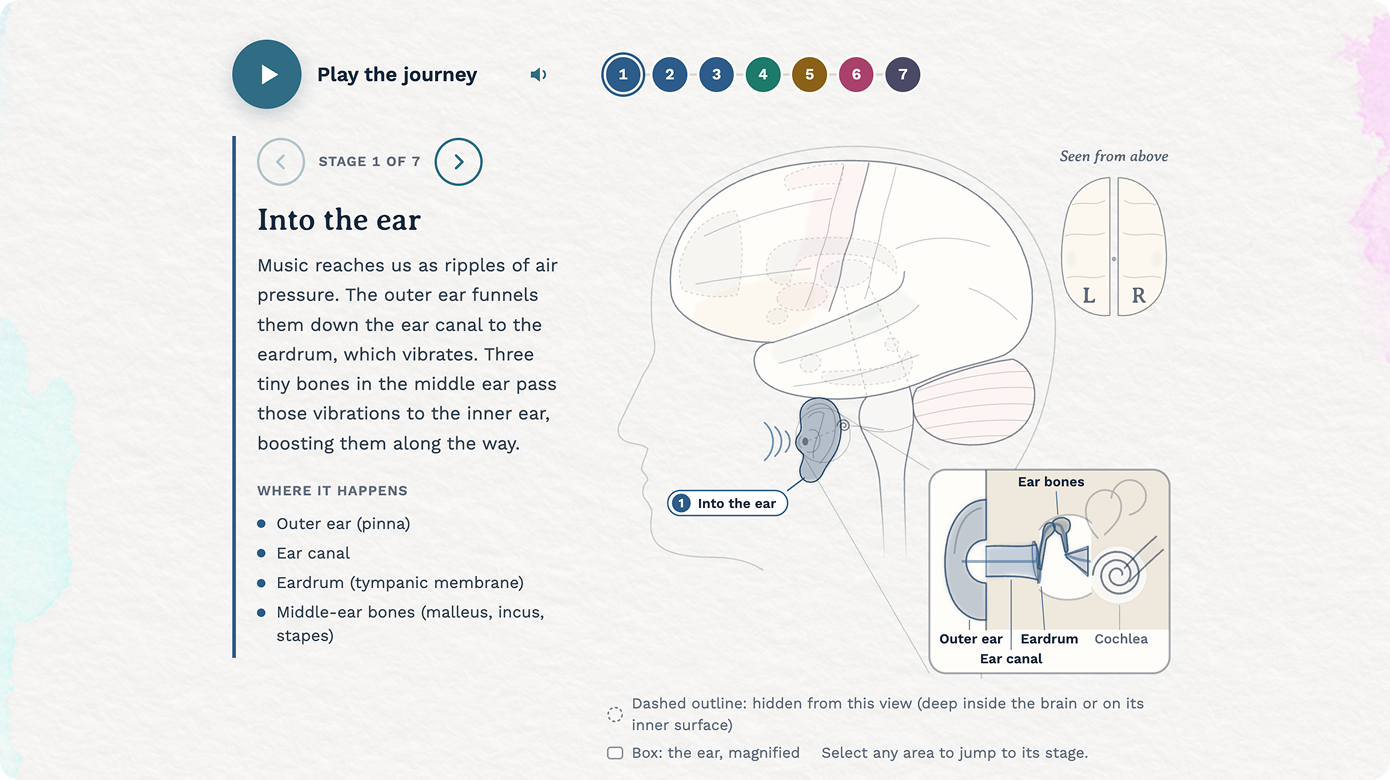
Music and the Brain
Follow music from your ear through the brain, one step at a time.
The Music We Carry With Us
Research can help us understand what music may do. But perhaps part of what makes music so remarkable is that its place in our lives begins so early and can continue for so long.
In infancy, music is the cadence of a caregiver’s voice. Throughout childhood, it becomes a medium for play, learning, movement, identity, and belonging. During adolescence, a song might help a young person name emotions that are difficult to explain. In adulthood, music can mark celebrations, sustain communities, and hold the stories of who we are.
And late in life, as I saw with my dad, familiar music may still offer a path to emotion and connection.
A 2025 Cochrane review of music-based therapeutic interventions for people with dementia found that, compared with usual care, they likely improved depressive symptoms slightly and may have improved overall behavioral problems at the end of treatment. The evidence did not show clear benefits for cognition or agitation, and evidence for longer-term effects remained limited or uncertain.
That distinction matters. Music cannot reverse dementia. But that does not mean the moments of recognition, comfort, or connection it can sometimes create are insignificant.
Today, my dad lives in a nursing home. In the evenings, when he experiences the confusion and agitation often associated with sundowning, the staff play classical music to soothe him.
We don’t play our old game anymore. But he still knows the music.